I often hear about the struggles of parents of young children with thermometers when their children have infections. Significantly different readings taken with a newly purchased, recommended thermometer, different readings on different parts of the body, and finally, discrepancies between different thermometers can drive carers themselves crazy.
One time it shows 37.2 and another time 38.6, so does the child have a fever or not?
In order to take a comprehensive look at the subject, we need to take a moment to consider recommendations and physiology. There are several methods available for measuring temperature. According to Polish and international guidelines, the gold standard for young children is rectal temperature measurement. However, the technical difficulty of the measurement (such as measuring a sleeping child or the risk of injury) means that parents rarely use this method.
Axillary measurement also presents challenges in terms of measurement technique and discomfort for the child. The temperature on the eardrum accurately reflects the internal body temperature, but the measurement can be easily distorted by the anatomy of the external ear canal (difficulty in straightening it) and often by earwax. As a result, we can rarely be sure that the thermometer measures the actual temperature on the eardrum.
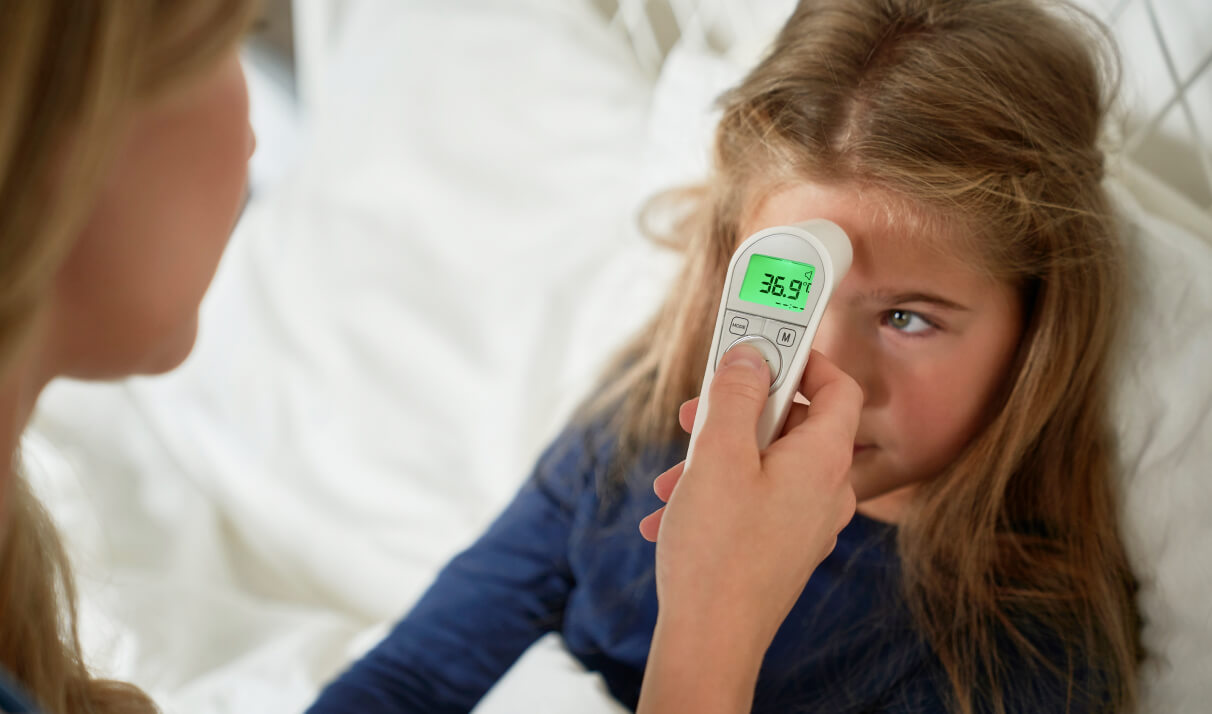
The most popular and convenient method of measurement is non-contact measurement on the child’s forehead. However, this is where parents have the most doubts due to the variety of readings. Recommendations advise caution when using this method of measurement and treat it as a screening method.
So, should you buy a new thermometer? Not necessarily. Instead, you should learn about the reasons for the variability in measurements and learn to observe your own child.
What causes differences in forehead measurements:
1. The influence of the external environment.
The temperature of the forehead skin is susceptible to the influence of ambient temperature, humidity, sweat, or recent contact with cold or warm air. Simply taking a measurement immediately after removing a hat or under thick bangs can inflate the result (in such cases, expose the forehead for a few minutes before taking the measurement).
2. Technological differences and device algorithms.
Thermometers should be used according to the instructions! Some are calibrated for the centre of the forehead, others for the temple. The method of measurement and the recommended distance from the skin also vary. Parents have often lost confidence in thermometers because they show a different temperature on the forehead than on the neck, for example. Yes, we are a warm-blooded species, but differences in skin temperature in different areas of the body are physiological.
3. The temporal artery and thin skin in children.
In children, the skin on the forehead is thinner, better supplied with blood and reacts more quickly to changes in ambient temperature. The course of the temporal artery just below the surface of the skin means that measurements taken in this area may be closer to the internal body temperature, but even a slight shift in the measurement site can significantly lower the result. In adults, this variability is much smaller. Hence, it is often observed that the caregiver ‘measures correctly’ and the child ‘measures incorrectly’.
Studies have shown that the differences between measurements taken on the forehead with a non-contact thermometer and other methods (axillary, tympanic, rectal) can exceed 1°C. This carries the risk of overlooking a fever in a child as well as the risk of overdiagnosing an elevated body temperature.
However, we must not forget that the measurement result itself is only one of the symptoms of fever. As they get older, parents get to know their child and learn to assess other symptoms such as weakness, drowsiness, tremors and feeling cold, flushing, paleness, ‘glassy eyes’, lack of appetite, mood deterioration, and an increased need for closeness to the caregiver. All these symptoms, combined with a high reading on the thermometer, suggest fever. If in doubt, it is a good idea to have a thermometer at home that allows you to verify the reading using a different measurement technique.
However, if you take your child’s temperature shortly after they get out of bed, on their forehead, which was still touching the pillow a moment ago, the result is elevated but the child does not show any other worrying symptoms, verify the measurement based on the knowledge you already have 🙂
Bibliography:
1. Clinical Accuracy of a Non-Contact Infrared Skin Thermometer in Paediatric Practice. Teran CG, Torrez-Llanos J, Teran-Miranda TE, et al. Child: Care, Health and Development. 2012;38(4):471–6. doi:10.1111/j.1365-2214.2011.01264.x.
2. Non-Contact Infrared Versus Axillary and Tympanic Thermometers in Children Attending Primary Care: A Mixed-Methods Study of Accuracy and Acceptability. Hayward G, Verbakel JY, Ismail FA, et al. The British Journal of General Practice. 2020;70(693):e236–e244. doi:10.3399/bjgp20X708845.
3. Non-Contact Infrared Thermometers Compared With Current Approaches in Primary Care for Children Aged 5 Years and Under: A Method Comparison Study. Van den Bruel A, Verbakel J, Wang K, et al. Health Technology Assessment. 2020;24(53):1–28. doi:10.3310/hta24530.